
Notes from the Workshop
An Exceptional Gift for the Hunter
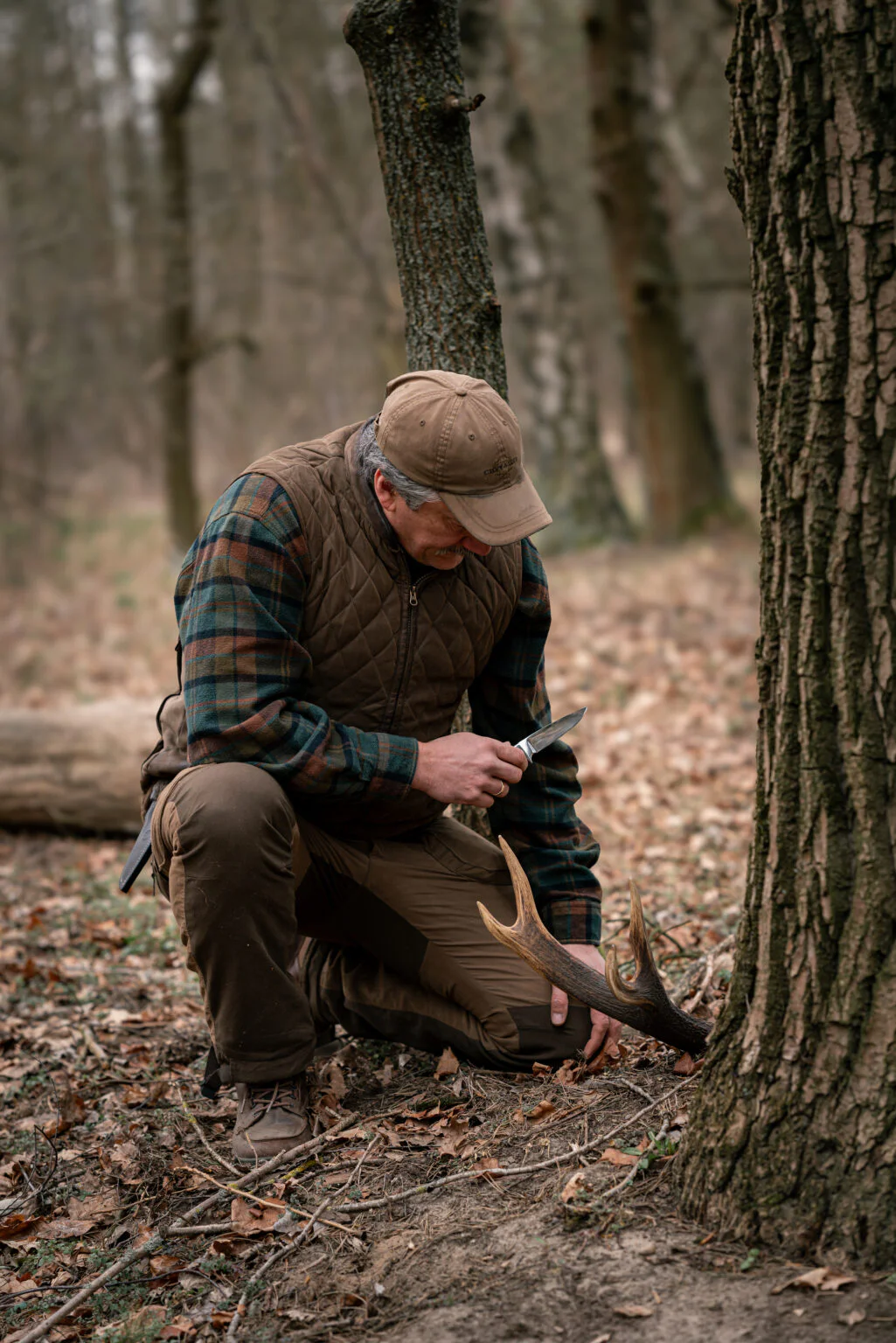
Table of contents
Why is a knife such a special gift?
You know the feeling. That moment when you're trying to buy a gift for the man who has everything. Maybe it's your father's 50th birthday, your husband's silver wedding anniversary, a longtime business partner's well-earned retirement, or simply a way to show your best client some appreciation. You want to give him something exceptional. Something he'll remember, something that shows you genuinely put in the effort to make him happy. And so the search begins. A watch? He's probably got a few already; there's a good chance one more just becomes one of many, and ends up in a nightstand drawer. A fountain pen? Beautiful, prestigious, but... let's be honest, it doesn't exactly stir up strong emotions, does it? Jewelry, a tie, a top-shelf bottle of something? Not bad ideas. But they've all been done before.
A handmade hunting knife isn't necessarily the first thing that comes to mind — which is a shame, because it's a compelling gift idea for a distinguished man. Not just a hunter. A good knife has a different nature. It's not purely decorative. Its purpose isn't just to look good in a study, though it certainly can. It's a tool that participates in its owner's life. You can take it hunting, into the mountains, camping, on a fishing trip. You can use it to prepare a meal, cut kindling for a fire, dress game, cut a rope, open a package, carve a steak at the table. A knife doesn't need power, updates, a charger, or ink. It works from day one, and it can keep working for decades. That's exactly why its sentimental value often outstrips that of many objects that seem, at first glance, more "giftable."
There's one more thing. Watches and pens, even the finest ones, typically come out of a factory. Precise, beautiful, polished — but repeatable. The Ratel is made differently. Every piece passes through the maker's hands: from working the steel, through grinding, to the details, the engraving, and the hand-stitched sheath. No two knives are identical. Each one carries the mark of the person who made it. That story then meets the story of the person who owns it.

An exceptional gift for the man who has everything
A good knife doesn't age the way so many modern objects do. It doesn't go out of style after one season. You don't have to replace it with a new model just because a newer version came out, or a scratch appeared on the blade. A knife like this takes on character over time. The handle learns the shape of the hand; the steel picks up marks from use; the sheath settles into its owner's rhythm. That's exactly what turns an exceptional gift for a hunter into something more than a present handed over on a special occasion. It can stay with him for years. Is a knife a good gift? Sometimes there's an objection: "But he doesn't hunt." That's fine. The Ratel is a hunting knife, but its usefulness doesn't end in the field. It works just as well on a mountain trip, a family camping trip, a fishing outing, working around a campfire, or preparing food outdoors. It can also sit in an elegant box as a collector's piece, a decorative object in a study, or a keepsake marking an important occasion. What matters most isn't the hunting itself, but the mindset of the person receiving the gift. It has to be someone who understands the value of things made with intention. Someone who appreciates objects that are solid, durable, and genuine.
A hunting knife as a gift?
A hunting knife makes a great gift when you know the character of the person receiving it. It's not a random gadget, or a safe, neutral pick out of a catalog. It's an object with a clear personality. That's why it works best for a man who values independence, craftsmanship, nature, tradition, or well-made tools. For someone who appreciates objects with a story. For a father, a husband, a son, a friend, a business partner, a client, a mentor.
For centuries, giving a knife has carried symbolic weight. In many cultures, it was a sign of maturity, trust, and responsibility. A knife worn at the belt said something about a man's independence. Giving one to a young man could mark his entry into adulthood. Exchanging knives was often a gesture of friendship, loyalty, or respect. Richly decorated hunting knives were, for centuries, prestigious gifts too. They were presented on important occasions, as thanks, as a mark of respect, or as a symbol of connection. It was never just about the tool. It was a message: I see you, I respect you, I value you. That meaning hasn't disappeared. Today it may be less obvious, but it's still understood. A well-chosen knife isn't a controversial gift. It's a symbol of responsibility, trust, and good taste.
If the recipient actually hunts, the Ratel hits even closer to home. A hunter grows attached to his knife in a way that's hard to explain to someone on the outside. It's not just about a sharp blade. It's the handle that sits right in the hand, the weight, the balance, the secure grip, the familiar motion of reaching for the sheath. Hands have their own memory. After years of use, a hunter recognizes his own knife without even looking. At that point, the knife becomes part of a ritual. It's there for the preparations, the trips, the hunts, the return home, the gatherings around the table. It's on the belt exactly when it should be. When it's missing, something feels off. There's also a matter of elegance. Hunting, especially group hunts, isn't purely fieldwork. It's also a gathering, a tradition, a community, a certain code of conduct and appearance. A random knife in a plastic sheath doesn't belong alongside well-kept clothing, polished boots, and a carefully chosen firearm.
A well-dressed hunter deserves a well-made knife. Picture the table after a hunt. Roast venison, conversation, toasts, stories from the woods. At some point, someone pulls out a knife to carve the meat. Not just any knife. Handmade, engraved, with a beautiful handle, in a leather sheath. An object that couldn't be mistaken for anything else. No one at that table will miss a knife like that. And years later, a sentence might come up that matters more than the gift itself: "My father hunted with this knife." Or: "I got this on my first hunt. It's been with me ever since."
Engraving, the box, and a personal gesture
Personalization is the moment when an exceptional gift stops being just an expensive object. It becomes "the" gift. Anyone can buy a knife. But not everyone will take the time to think through initials, a date, a monogram, a family crest, a symbol, or a small mark that will only mean something to that one person. One thing costs money. The other requires attention. And it's usually the attention that people remember most.
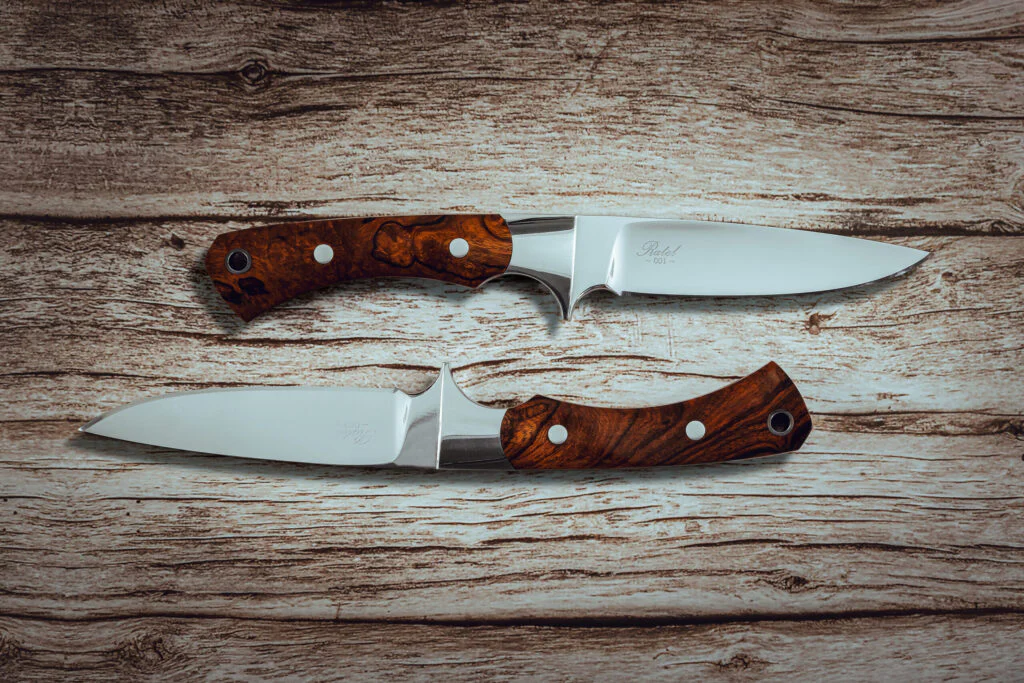
On the Ratel, personalization can appear in a discreet but meaningful spot: the guard, the piece that connects the handle to the blade and protects the hand from the edge. It's a small space, but one that's visible every time the knife is drawn from its sheath, and every time it's used. That discretion is exactly where its power lies. You can place initials, a monogram, a birth date, the date of a first hunt, a retirement, a promotion, or an anniversary there. If the family has a crest, that can become part of the design too. Alongside the scrollwork or foliate motifs, a mark appears that makes the knife belong to one specific person. Hand engraving carries a different character than laser engraving. Every line has depth, rhythm, and a trace of the work behind it. It's not perfectly mechanical, because it shouldn't be. That's exactly what gives it life.
The finishing touch is the presentation. Before the recipient even sees the knife, they pick up the box. They feel its weight, see the grain of the wood, notice the proportions and the finish. The first impression forms before it's even opened. The packaging isn't just for shipping protection. It's part of the experience. Part of the gift's story. This isn't the kind of box that gets thrown away. It stays on a shelf, in a study, in the home. It holds the object, but it also holds the memory of the moment it was given. Inside lies the knife. Right next to it, the sheath. And there's also a certificate: the piece's number, the date it was made, its specifications, the maker's signature. A document that, years later, will still tell the story of what this object is, when it was made, and whose hands made it. That matters, because the Ratel isn't an anonymous product, one of hundreds of thousands of identical items. It's a numbered piece. A specific knife, from a specific series, made at a specific time, for a specific person.

A gift as part of the family's story
Dla syna, zwłaszcza przy osiemnastych urodzinach albo pierwszym polowaniu, nóż może być symbolem wejścia w dorosłość. Dla męża może być prezentem od żony, która rozumie jego pasję, potrzebę własnej przestrzeni i przywiązanie do rzeczy, które są tylko jego. Nie domowe, nie wspólne, nie codzienne. Osobiste. Dla przyjaciela albo partnera biznesowego będzie podarunkiem eleganckim, ale nie banalnym. Wystarczająco osobistym, by został zapamiętany, a jednocześnie odpowiednim w relacji opartej na szacunku, lojalności i wspólnych doświadczeniach. Dla najlepszego klienta może być podziękowaniem, które nie przypomina firmowego gadżetu. Nie jest ulotką, zestawem z logo ani kolejnym przedmiotem bez znaczenia. Jest trwałym gestem uznania.
There's a story every one of us can easily picture. A family's father receives a knife on a significant, likely round-number, birthday. Personalized, packaged in a wooden box, with a leather sheath and a certificate. He hunts with it for years. He knows its balance, its handle, its guard, its weight. He knows how it sits in his hand, and that he can rely on it. One day, he sits down somewhere with his son. Maybe by a campfire, maybe at the table after a hunt. He takes out the knife and says: "It's yours now." The son carries it for years to come. He remembers that moment, because you don't forget things like that. And then, one day, he sits down with his own son and says: "I got this knife from my father, your grandfather. Now I'm passing it on to you." One knife holds the power to connect several generations. It strengthens relationships, carries history forward, stirs memories. For centuries, a knife was a gift that meant something. It said: I trust you, I respect you, you're worthy. That tradition hasn't disappeared. It just needs to be remembered. Maybe the Ratel will be the knife that does that for you.
If you already know who this knife is for, write or call. We'll talk through personalization, the handle wood, the engraving, and the piece number. Turnaround is usually six to eight weeks, so a gift like this is worth planning ahead of time.