
Notes from the Workshop
The Knife as Functional Art
Picture a richly decorated hunting knife. Intricate ornamentation can make a knife awkward in the hand. Gilding can wear off, gemstones can fall out, and the engraving itself can be so delicate that it wears away over time. A lot of people wonder whether a knife like that even belongs in the woods. On the other hand, you'll sometimes see a well-dressed hunter carrying a plain work knife with a plastic handle in a plastic sheath at his belt. That kind of pairing catches the eye immediately, the way worn-out shoes look wrong with an expensive suit. So can a hunting knife successfully live in the space between pure function and art?

Table of contents
Between two masters
Later in my career as a knifemaker, Alain Lovenberg came to have an enormous influence on me. Alain is one of the most renowned engravers of fine sporting arms in the world, and I have the privilege of studying under him. His work never fails to leave a deep impression on me. He decorates the most exclusive sporting guns in the world, creating engravings for the most demanding collectors. He has his own recognizable style. A gun engraved by his hand is often so richly decorated that it essentially becomes a work of art. Of course, it can still be fired, since it's still a fully functional firearm, but he himself says it's not a gun meant for the hunt.
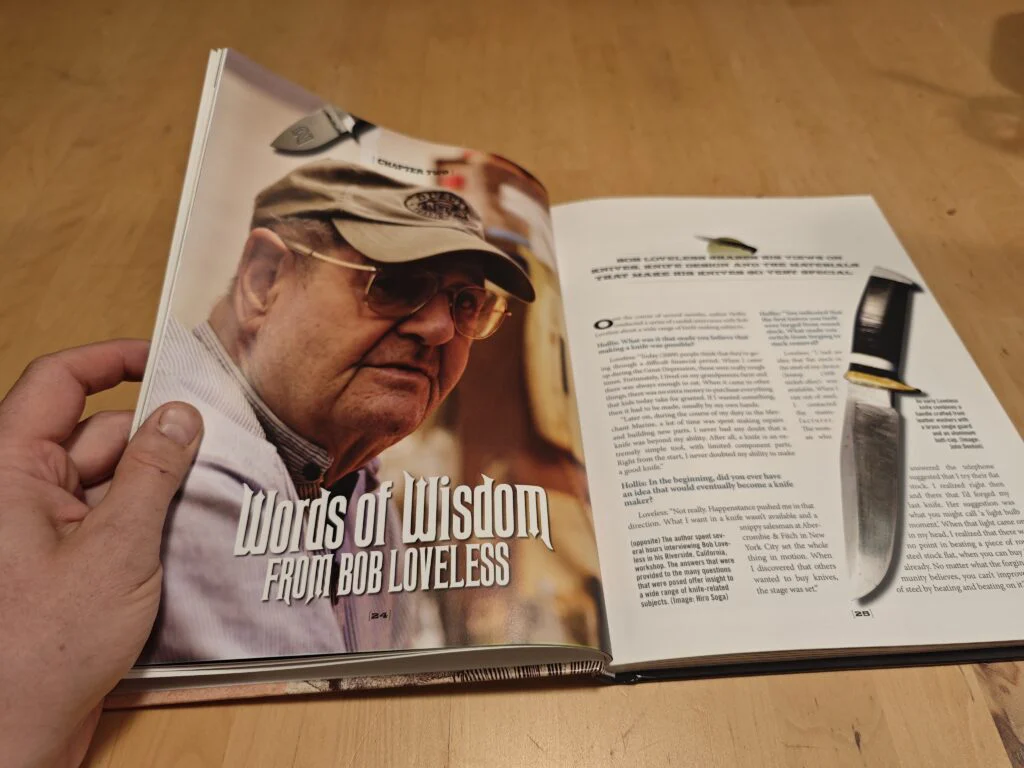
As you can see, these are two entirely different approaches. On one end stands Master Loveless, a craftsman through and through. On the other stands Master Lovenberg, an artist devoted to his art. Somewhere in between, I've been looking for a place of my own. I've long wondered whether it's possible to find a balance between beauty and function.
Finding my own path
For a while, I followed Loveless's path. It felt natural to me. I picked up the craft quickly. I made hunting knives — good tools, solid, well thought through. And I was satisfied with that. But at a certain point, something started stirring in me. An artistic streak, demanding something more. I didn't know exactly what yet, but I understood that pure utility wasn't enough for me anymore. That I wanted to give my knives something more of myself.
I never imagined, in my whole life, that I'd take up engraving. In my mind, it was something out of reach. I always loved the look of decorated firearms — I even have a piece from my father. But actually making something like that myself, with my own hands, in steel? It turned out I could — even at nearly 50 years old. I got to work, and I learned. Reaching the level of my mentor, Lovenberg, will be a hard climb, but on the other hand, that's not really my ambition. I have no plans to engrave firearms worth hundreds of thousands of dollars. I just want to master one narrow craft: engraving my own knives.
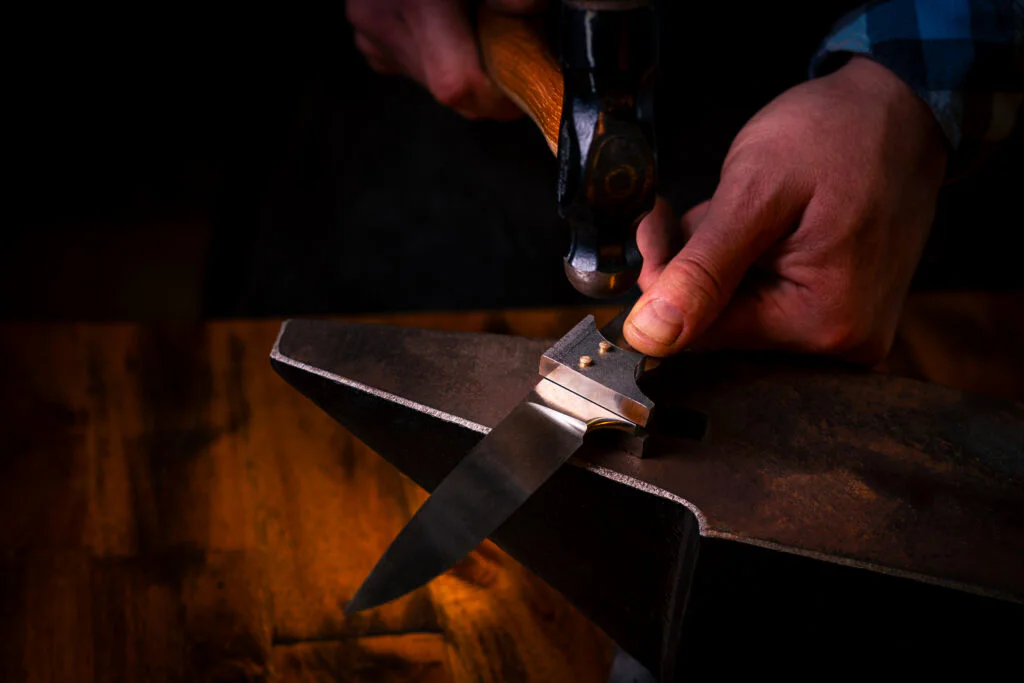
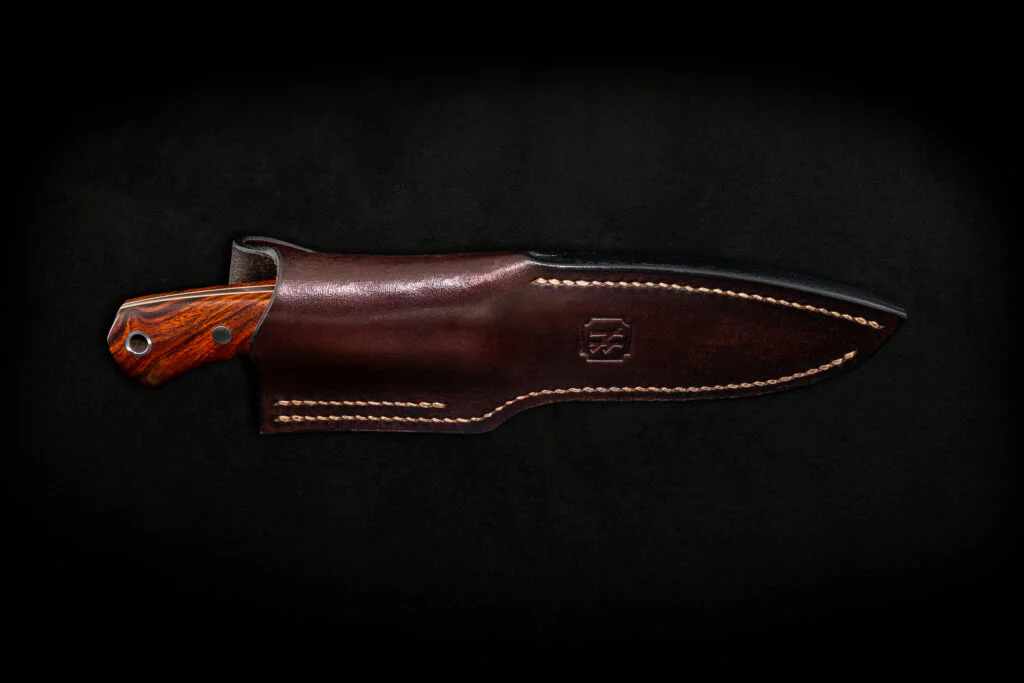
And so, at the meeting point of two worlds, where artists and craftsmen come together, the Ratel hunting knife was born. I managed to create a solid working knife — comfortable, sharp, corrosion-resistant, safe — and at the same time decorated with engravings on par with what I see on my own shotgun, and on the guns of fellow hunters who actively hunt with them. A versatile knife that holds its own in any situation.
Three elements make a whole
A fragment of history
I have a big solid-wood table at home that's been in our family for quite a while. At first glance, nothing special — an ordinary piece of furniture, showing signs of wear. But for our family, it's something else entirely.
When my younger daughter was little, barely taller than that table, in a fit of dramatic toddler outrage, she decided to show us just how furious she was by biting the edge of it with her own teeth, leaving deep marks behind. If I hadn't seen it happen with my own eyes, I'd have assumed it was our dog's doing. She did it so fast that no one had time to react. The table was still fairly new to our home at the time, and my wife and I felt a pang of regret over the damage to something new. A few years later, we were moving, and my wife said maybe it was time to swap out this "damaged" table for a new one. At first, I agreed with her. But over time, it started to sink in that I actually wanted to keep that table, even if it didn't quite match the new house. What convinced my wife was my argument: "Those little teeth marks are a trace of our daughter. I don't want to part with it." To this day, we still eat our meals at that table. Sometimes we remember what it was like when the girls were small. That table has something irreplaceable about it. It's part of our family's story. And it's the same with a knife.
The first scratch