Notes from the Workshop
The Road to the Ratel Hunting Knife
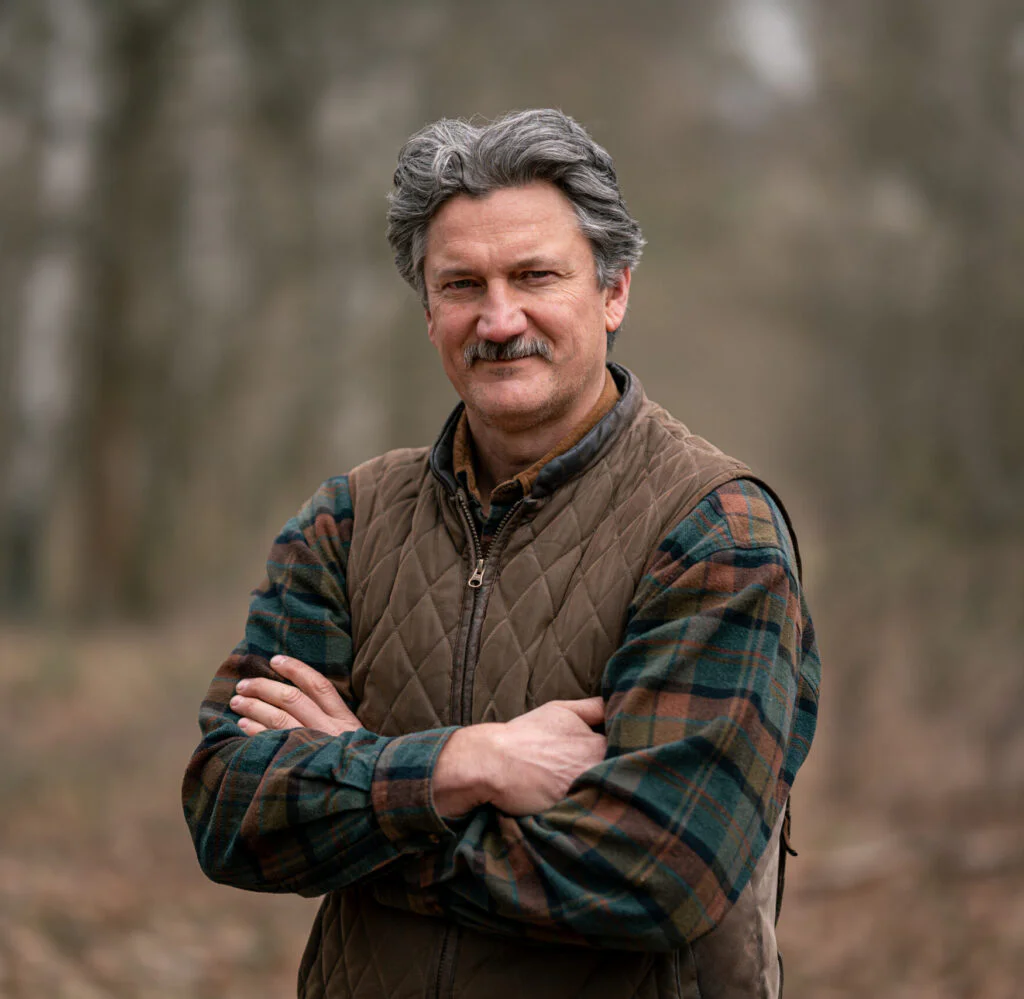
This is a personal story about the road that led me to knifemaking, and how the handmade hunting knives at Zdunek Knives come to be. It's a story about hunting, working with your hands, the pursuit of mastery, and about the Ratel — the knife where I've brought together everything I care about most in craft.
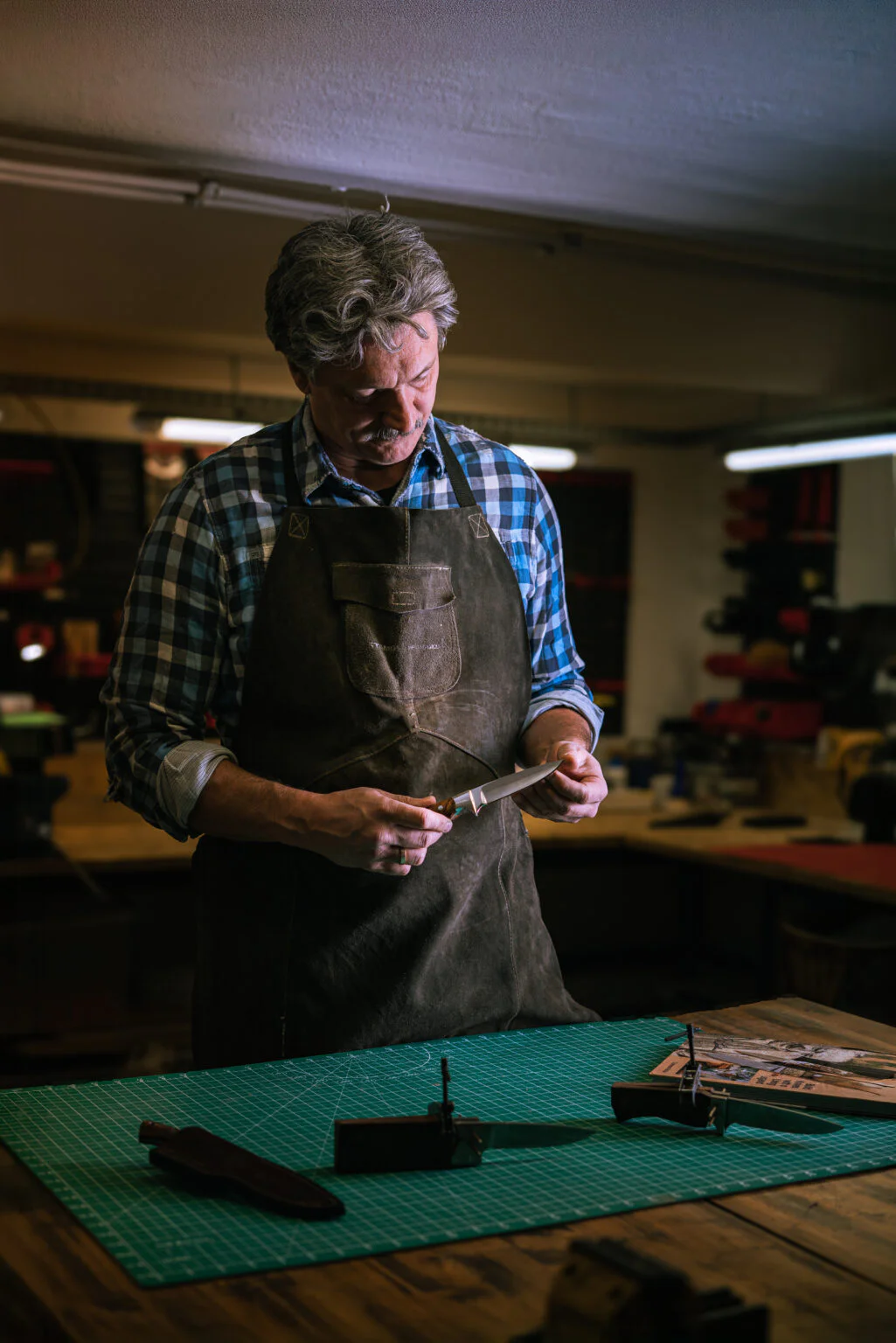
Table of contents
How I ended up where I am now
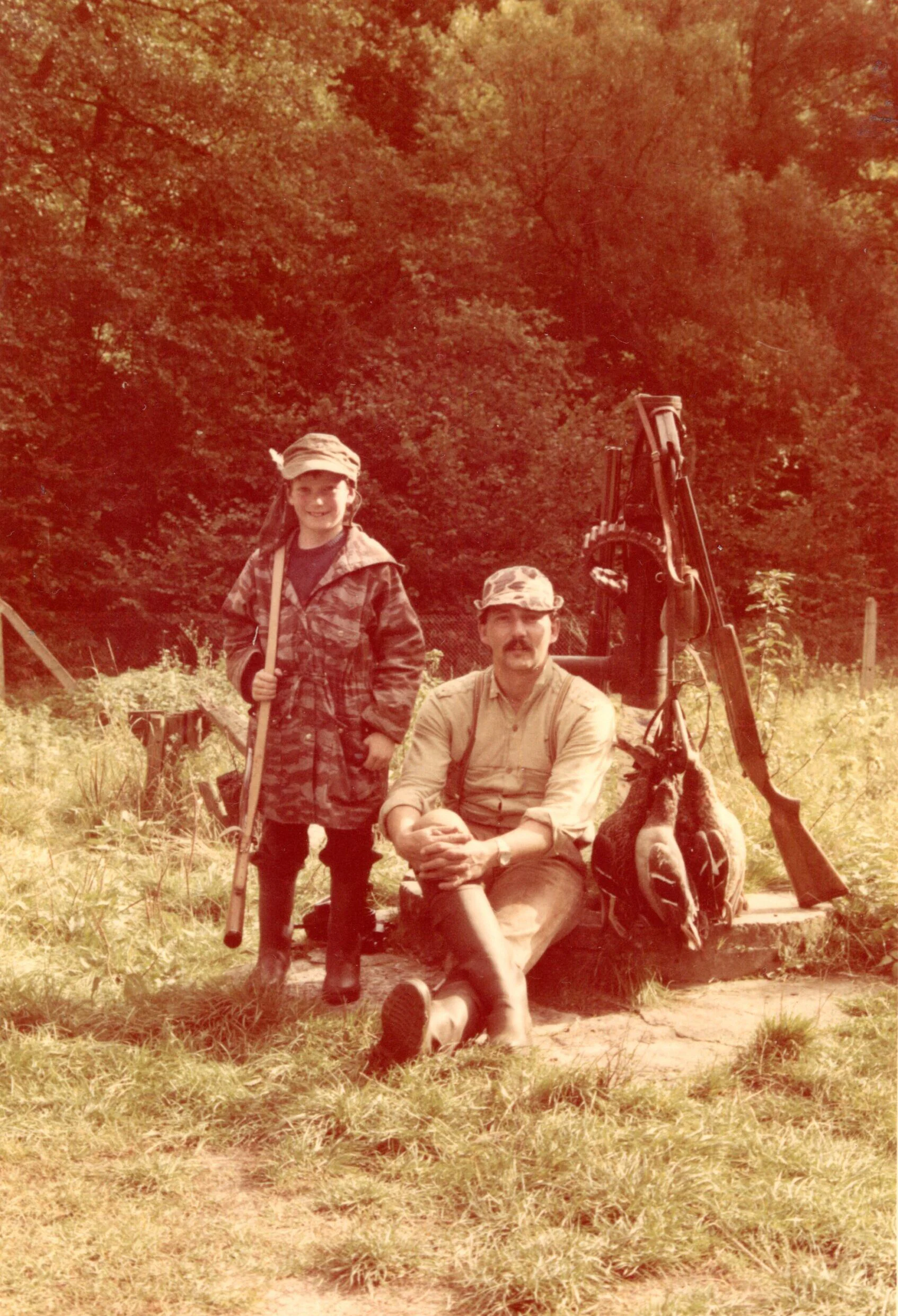
I come from a family with hunting traditions. My grandfather Leonard introduced my father, Andrzej, to hunting, and my father in turn introduced me to that world. He took me hunting from the youngest age. He showed me how to handle a firearm, how to behave in the woods, how to read tracks and stalk game. He taught me to shoot accurately, to hold a knife correctly, to field-dress game, and to cook the best wild boar liver you'll ever have. Around the campfire, he'd tell me stories about his adventures in the woods, about hunting ethics and culture, about respect for animals and the natural world around us.
Being a hunter matters to me. I feel close to nature — like part of it. I can go into the woods, spend good time there, rest, and bring home valuable, healthy food for my family. The fresh smell of the forest after rain, snow, a full moon on a cold winter night, morning mist over the meadows, the smell of gunpowder and gun smoke — all of it stirs up something in me from my younger years.
Discipline, sport, and character
My character was also shaped enormously by martial arts, which fascinated me from childhood. Judo, which I trained in for many years as a young man, taught me hard work on myself, discipline, and respect for my sensei and for the art itself. My coach also instilled in us a kind of young samurai's code: compete honestly, work on yourself, and keep improving regardless of the outcome. I was a capable, promising competitor. I discovered in myself a spirit of competition and rivalry. That's also when I first tasted victory — and it wasn't only about beating others, but about becoming a better version of myself.
After judo, at my father's suggestion, I started down another athletic path — this time, skeet shooting. I was a good competitor, winning medals at the Polish, European, and World Championships. I dreamed of becoming an Olympic champion, but life brought me back down to earth. As an adult, I had to make a decision: keep pursuing athletics professionally, or start earning a living another way? I chose to give up a career in sport and go to university to study management and marketing.
Argali: the family business and a lesson in responsibility
After college, our family's hunting traditions turned into a family business. My father and I founded the Argali hunting outfitter. For nearly 20 years, we organized hunts in Poland and around the world for hunters from Poland, Denmark, Finland, Norway, Spain, and Germany. I met a lot of wonderful people — loyal business partners, dedicated employees, and clients bound to us by mutual trust. There were disappointments too; occasionally, though rarely, we ran into dishonest clients and business partners. We managed to build a recognized brand, our clients' trust, and strong relationships with our partners. It was an important chapter of my life. It taught me responsibility, how to work with people, and how to run a business in an industry I'd known since childhood.
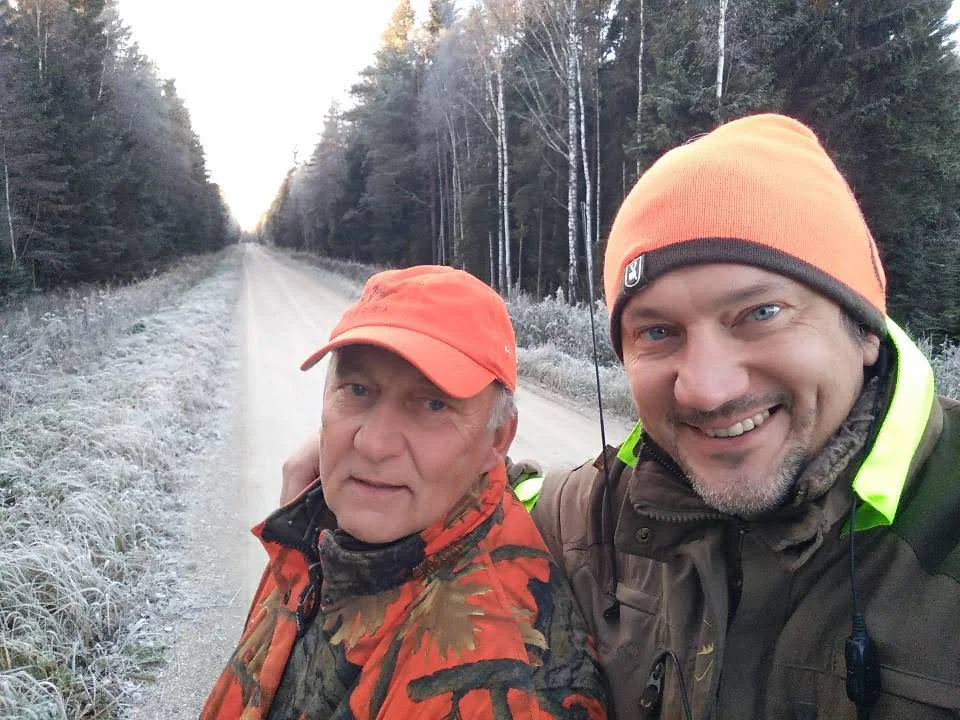
At a certain point, though, I realized it would be hard to build a stable, lasting business in the hunting-trip industry. Too much of it depended on other people, on regulations, on the weather, and on the mood of public opinion.
The thought started to form that it would be wonderful to be able to offer people my own product, or my own service — something I could be fully responsible for, my own brand, something I had direct control over.
The moment of waking up
Something inside me was stirring. I could feel it, but I didn't fully understand what it was. Now I know it was a deep, hidden need to create. At a certain point, professional burnout set in, along with an inner sense of hopelessness, even though on the surface my life looked well put together. I had a family, a home, a well-running business. And yet I felt like something was missing.
That was my wake-up call. I was ready for change. I decided to leave the family business and look for a different path — even though, at the time, I had no idea where it would lead.
My first knife
I never once thought, in my whole life, that I'd become a knifemaker.
After stepping away from the hunting-trip business, I spent a few years looking for something for myself. I tried my hand at real estate. I went to workshops in woodworking, leatherworking, blacksmithing, and traditional Polish stove-building. I could feel that the direction of handcraft was right for me, but it wasn't until I made my very first knife, at a multi-day knifemaking course, that I felt I'd finally found the right place. I found everything there that I've always loved doing: inventing, designing, drawing, tinkering, cutting, drilling, grinding, carving, gluing, and stitching.
Granted, at that first course I made a kitchen knife (to this day, it's still the most important knife in our kitchen), but I never went back to making kitchen knives again.
Why handmade hunting knives, and not... kitchen knives?
I thought hard about what kind of knives to make. What suited me best? What did I enjoy most? Where was I most authentically myself?
I tried different forms: bushcraft knives, hunting knives, folders. In the end, I settled on hunting knives, which I'd been around since I was a kid. I experimented with different types of steel, different thicknesses, handle materials, blade shapes, handle geometry, grind types, sharpening methods, blade lengths, and blade widths. I talked to hunters, asked their opinions, and had them test my handmade hunting knives.
Over time, it became clearer and clearer that a hunting knife wasn't just a tool for me. It's an object where function, craftsmanship, an understanding of the forest, and my own personal history all come together.
Refining the form
I read books, studied knives made by other craftsmen, and worked through nearly every source I could find. I trained in Poland and under master knifemakers in Austria.
But the biggest influence on my philosophy, techniques, and workshop practice came from Bob Loveless, who passed away many years ago, and who created the most famous hunting knife in the world: the drop-point hunter. Drop-Point Huntera.
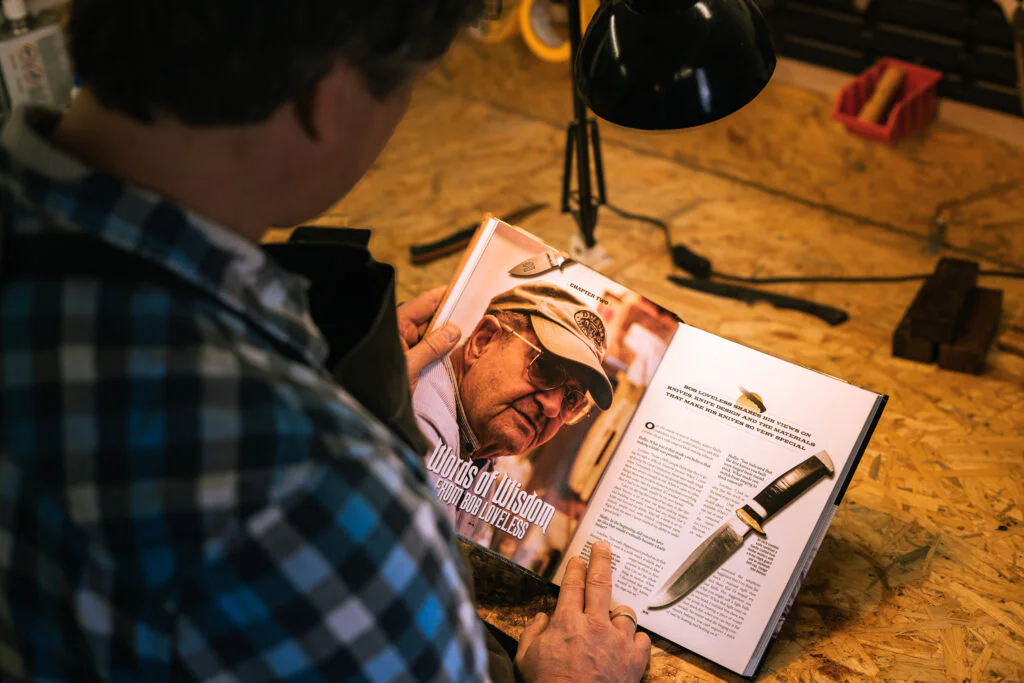
I studied his nearly two-hour film countless times, absorbing every word and every second of the footage. I put his techniques into practice, tested them, repeated them, and adapted them to my own work. Bob is my mentor, and even though I never met him, I know his spirit lives on in every knife that leaves my hands.
Engraving as a personal signature on handmade hunting knives
A few years in, once I was happy with the quality and look of my knives, I started wondering what I could do to make them even better, and even more beautiful.
That's when I thought back to a shotgun my father had given me long ago — a beautiful gun made at the Browning FN works in Belgium, engraved by a master engraver. I wanted my knives to inspire the same sense of awe I feel every time I hold that gun.
That's how my journey into engraving began — another building block in developing as an artisan.
Once again, I dove into the internet and into books. I took lessons from some of the best engravers in Poland and Italy. I bought the right equipment, and after several months of intensive study, the first engravings started appearing on my knives.
One model instead of many
A steady stream of thoughts kept circling (and still circle) through my head, all coming down to one question: what do I need to do to keep getting better at what I do? It's stronger than me. I can't control it. The drive toward mastery is, on my part, something of an obsession. I know that.
Here's how I reasoned it through: I got into knifemaking relatively late, in my mid-forties, so I don't have an unlimited amount of time ahead of me. Realistically, I could count on around 20 to 25 years of working in this craft. It became clear to me that if I wanted to become a master, I had to find a way to do it.
I thought it over for a long time. At some point it hit me: I couldn't make lots of different knives for clients to pick and choose from. I couldn't make every knife different, custom to order each time. This couldn't be about producing a large volume of mid-quality knives.
It all came down to one simple idea: not quantity — quality. I needed to find my own path. Not repeat other makers' patterns. Choose a narrow specialization and pour all my time and energy into achieving mastery in that one niche. That's how the idea for a hunting knife I'd call the Ratel was born. One model. Refined to perfection, both functionally and visually.
Handmade hunting knives: what does that actually mean?
At the outset, a hunting knife is just a piece of steel for the blade and a piece of wood for the handle. But the process of making it is labor-intensive. A simple knife can be made by hand in about 10 hours. But that's just going to be an ordinary knife. To make a knife that looks and performs like a piece of functional art takes many times more time. In my case, that's up to 80 hours of work if the knife is engraved. The most time-consuming part is the hand finishing of the details: satin-finishing and polishing the blade steel, the guard, and the handle, along with designing and executing the engraving.
How the Ratel comes together: sculpture at scale
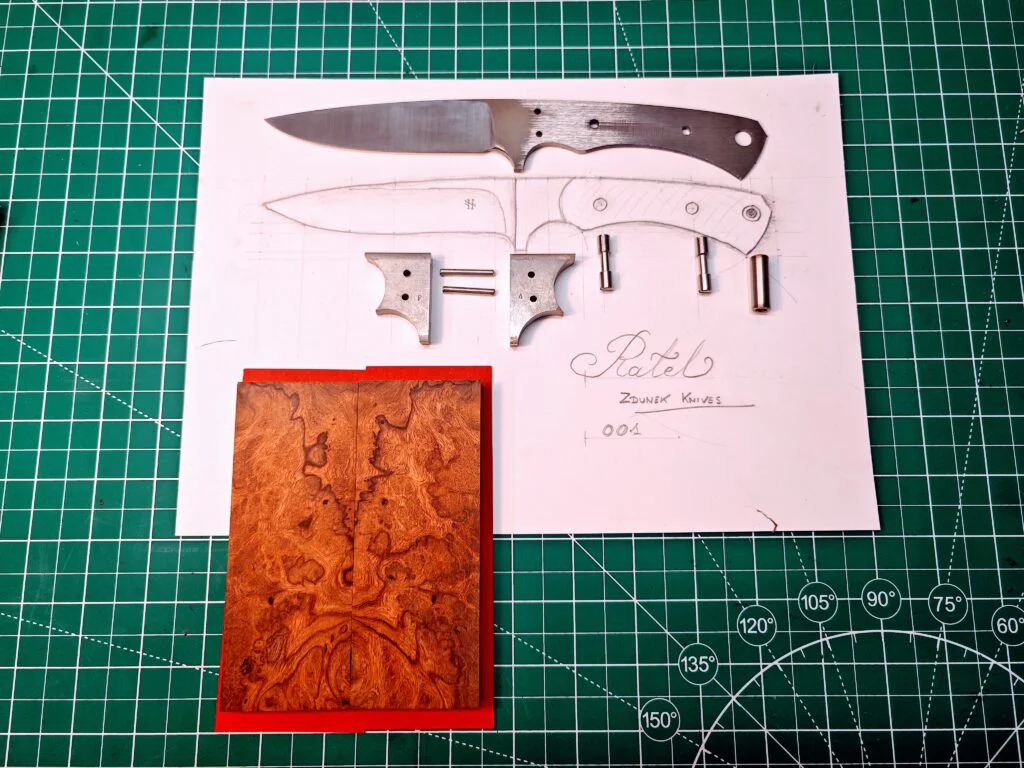
The whole process of making a knife in my workshop is, for me, a form of sculpting in wood and steel. First, I take the steel in hand, shape it, and grind the blade. Then I join the steel to the wood and shape the handle. That's sculpture at macro scale. After that, I engrave under a microscope, which is another way of saying: I sculpt patterns into the steel in very fine detail. Engraving, for me, is sculpture at micro scale. I suppose you could say I'm a sculptor. I sculpt knives. Rzeźbię noże.
Every element matters
Every shape, every element, and every material in my knives is deeply thought through. Nothing is left to chance: the drop-point blade shape, the full tang, the hollow grind, the thickness and length of the blade, the length of the handle, the type of steel, the tapered tang, how the steel guard is joined to the blade, how the wood is joined to the steel, the shape and geometry of the handle. Everything matters. My knives are designed and made to be strong, solid, durable, sharp, comfortable, safe, and beautiful tools in a hunter's hand. I want them to be an irreplaceable, reliable companion on every hunt.
Every hunting knife that leaves the Zdunek Knives workshop comes with a leather sheath fitted perfectly to it — also made entirely by hand. It mattered to me that a knife I'd put so much time into would have a home worthy of it. Cutting the leather, punching the stitch holes, hand-stitching with a saddle stitch, and finishing the edges of the sheath is also a labor-intensive process. If you want to get every detail right, there are no shortcuts here. Thanks to the right thickness and quality of leather, proper tanning, impregnation, and finishing, the result is a sheath that's beautiful, solid, and can serve its owner for many years.
What I love most is the moment I pick up a finished knife. I feel how well it sits in my hand in different grips, how comfortably it works, how the polished, well-sharpened blade looks. I check how the knife works with the sheath: does it come out easily, does it go back in smoothly, does it sit securely inside. I'll say it plainly: in moments like that, I feel pride and happiness. For me, it's a magic moment.
Why "Ratel"? Ratel?
Why did I name my knives "Ratel"? Ratel — also known as the honey badger — is a small animal in the weasel family. It's known for its fighting spirit, fearlessness, toughness, and endurance. I've been fascinated by this brave little animal for a long time. It occurred to me that its name would suit the hunting knives I make perfectly.
My knives, like the honey badger, are relatively small. Day to day, they live quietly in their sheath, not drawing attention to themselves — but they're sharp, tough, hard to dull, and unafraid of hard work.
Why will there only ever be 441 Ratel knives?
The inspiration for this idea came from the mysterious figure of Satoshi Nakamoto, who, in creating Bitcoin, wrote into its source code that there would never be more than 21 million coins. That's one of the qualities that gives it value and sets it apart in a world where the production of money knows no limit.
I estimated that, over my lifetime, I'd realistically be able to make around 500 knives, at most. That's when the idea hit me: make a subtle nod to Satoshi Nakamoto, and set in advance that there will never be more than 441 Ratel hunting knives. Twenty-one series of 21 pieces each. 441 knives, total, across my entire career as a knifemaker. The knife model stays the same, but every piece is, in its own way, one of a kind — and numbered.
A life's project
Through discipline and hard work, I finally managed to reorganize my life in a way that gave me the resources, the space, and the time for my own workshop.
And here I am. Many years later, in a completely different place. As I write these words, I'm 47 years old, working in my small manufactory of handmade, hand-engraved hunting knives: Zdunek Knives. This workshop has become the project of my life. A place in time and space where I use most of my natural talents, create functional art, and feel completely at home. I'm exactly where I was always meant to be. I'm doing what I love, and what I'm good at.
Every knife I make carries a real piece of my personal history. Fragments of my best self, hidden away in steel, wood, and leather. Every hunting knife is made using the greatest talents and character traits God gave me. It's a tool made with heart, with good energy, and with the hope that it will last, and be used, long after I'm gone.
I hope to be remembered as a true master craftsman, someone who brought together the art of handmade knifemaking and engraving. I'm giving everything I have to leave behind a good name, and to make my children and grandchildren proud of me. My journey is still ongoing. There are many more years of creative work ahead of me. Every next hunting knife I make will be better than the last. It will mature alongside me, as a maker. I hope that, someday, I'll earn the title of one of the finest makers of engraved hunting knives in the world.